

Free help for first-time founders
5 Mistakes First-Timers Make on the 501(c)(3) Application
Five slips that cost new nonprofits time, each with its IRS source and a plain fix. Read them free below. If you want every step, the full guide is $39.
The five mistakes
What first-timers get wrong, and how to avoid it
Each one comes from the IRS's own pages or instructions. We checked them against irs.gov on November 22, 2026.
1
Picking a form your group cannot use
Form 1023-EZ is the short, lower-cost form. You cannot use it if your gross receipts were over $50,000 in any of the past 3 years, if you expect them to pass $50,000 in any of the next 3, or if your assets are worth more than $250,000. Those groups file the full Form 1023.
The fix. Answer the three eligibility questions before you pick a form.
Source: IRS Instructions for Form 1023-EZ, Eligibility Worksheet (revised 01/2025)
2
Filing after the 27-month mark
File within 27 months from the end of the month you formed, and the IRS may recognize you as exempt back to your formation date. File later and your exemption generally starts when you apply.
The fix. Put the date on your calendar the day you incorporate.
Source: IRS, Form 1023 questions about applying more than 27 months after formation (updated 09-Oct-2026)
3
Sending an incomplete organizing document
The IRS asks for a complete copy of your organizing document and all its amendments, and for your adopted bylaws. Leaving either out is on the IRS's own list of reasons applications are delayed.
The fix. Check your list of attachments against the form before you submit.
Source: IRS, Top ten reasons for delays in processing exempt organization applications (updated 09-Oct-2026)
4
Not showing how your activities reach your purpose
The IRS wants enough detail about what your group will do to see how it will achieve its exempt purpose. A thin or vague description is on the IRS's list of delay reasons.
The fix. Describe real activities in plain words: who you serve, what you do and how often.
Source: IRS, Top ten reasons for delays in processing exempt organization applications (updated 09-Oct-2026)
5
Skipping the annual return after you are approved
Organizations that do not file for three consecutive years automatically lose their tax-exempt status.
The fix. Know which annual return your group files, and put its due date on the calendar.
Source: IRS, Automatic Revocation of Exemption (updated 28-Jun-2026)
Also on the IRS's list of delay reasons: the correct user fee, a signature from an authorized person, every required page and schedule, and complete officer and board information.
Want a hand with this?
Pick the help that fits
If you would rather hand a piece of it off:
If you want every step
The full guide behind these five
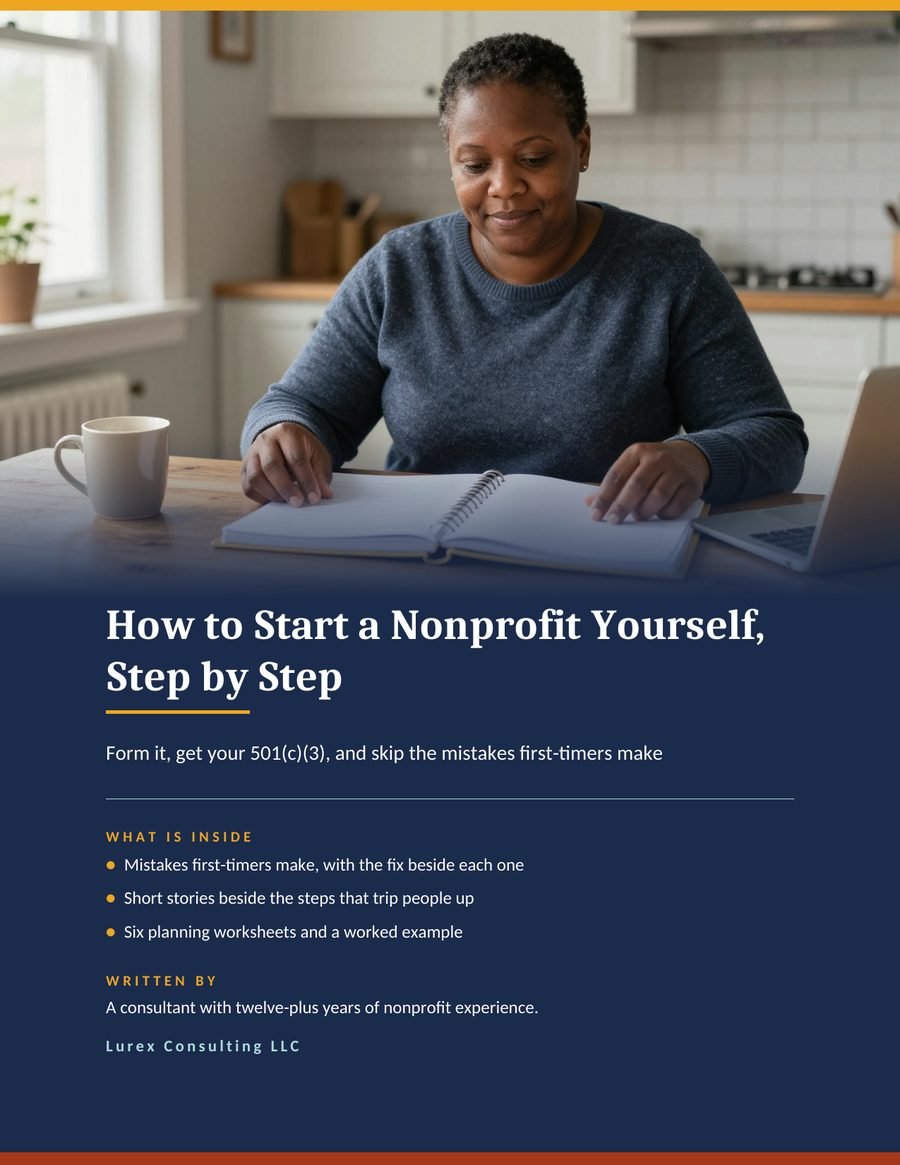
The five mistakes are a small part of it. The guide takes you from your first idea to your IRS application, in order, in plain English.
- The step-by-step guide as a PDF, with a Quick Start map, master checklist and timeline
- Six planning worksheets in editable Word, including a mission and purpose worksheet, a startup budget and a Form 1023-EZ eligibility check
- A worked example, Riverside Readers, so you can see what finished work looks like
- Watch-out boxes beside the steps that trip people up, each with its source
Questions
Before you buy
What do I get?
The full guide as a PDF, plus the six worksheets and the Riverside Readers worked example in one editable Word file.
How do I get it?
Choose Get the guide and check out on Stan Store, the Lurex Consulting store. The guide as a PDF and the worksheets in Word arrive by email right after checkout.
Does it work for my state?
The guide covers the federal steps in full and shows you how to find your own state's offices, forms and fees. Each state sets its own rules, so the guide points you to the official source for yours.
How current is it?
This is Edition 1.1. Its facts were checked against irs.gov and state government sources on November 21, 2026.
What if I get stuck on a step?
Email ops@lurexconsulting.com with your question or where you are in the steps.
Get the guide
How to Start a Nonprofit Yourself, Step by Step
$39
- The full guide as a PDF
- Six planning worksheets in editable Word
- The Riverside Readers worked example
Instant delivery. The guide as a PDF and the worksheets in Word arrive by email right after checkout.
You check out on Stan Store. Sold by Lurex Consulting LLC.
Want the forms prepared for you?
See the 501(c)(3) Filing →